

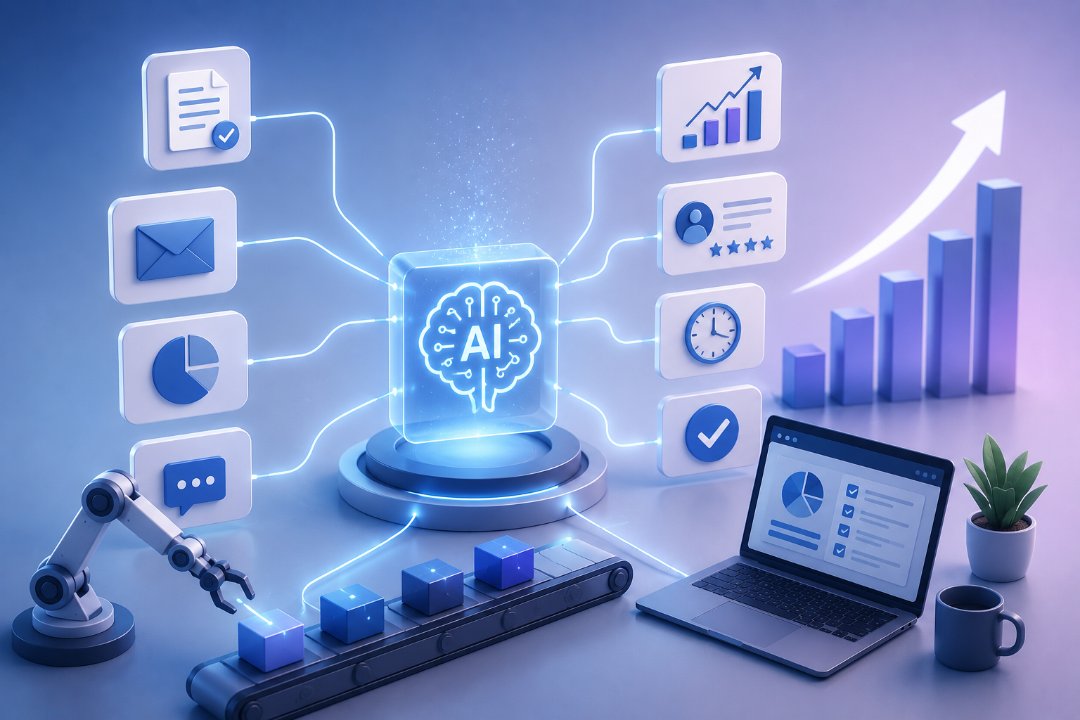
For most businesses in Oman and beyond, artificial intelligence has shifted from a “someday” experiment to an operational necessity. The organisations pulling ahead aren’t the ones with the biggest budgets — they’re the ones quietly weaving AI into the workflows and systems they already use every day. Integrating and adapting AI isn’t about chasing hype; it’s about unlocking the productivity and potential that otherwise stays buried beneath manual, repetitive work.
From Standalone Tool to Integrated Advantage
It’s easy to treat AI as a separate gadget — a chatbot here, a content generator there. The real returns appear when AI is embedded directly into your existing processes: your CRM, your support queue, your reporting, your approvals. When AI lives inside the workflow rather than beside it, every task it touches becomes faster, more consistent, and less dependent on a single person’s availability.
Adaptation matters as much as adoption. Off-the-shelf AI rarely fits your business perfectly out of the box. Tuning it to your data, your terminology, and your decision rules is what turns a generic model into a genuine competitive asset.
Where AI Quietly Reclaims Hours
The biggest gains usually come from the unglamorous work no one enjoys. Common high-impact areas include:
- Document and data handling — extracting, summarising, and routing information that staff would otherwise re-key by hand.
- Customer communication — drafting replies, triaging enquiries, and surfacing the right answer instantly.
- Reporting and analysis — turning raw numbers into plain-language insight without waiting for a manual report.
- Internal workflows — approvals, reminders, and follow-ups that move forward automatically instead of stalling in an inbox.
Each of these reclaims hours every week — hours your team can redirect toward the judgement, creativity, and relationship-building that machines can’t replicate.
Unlocking the Potential That Stays Untapped
Most companies are sitting on value they never see: data that’s never analysed, patterns that go unnoticed, and capacity lost to busywork. AI’s quiet superpower is making that latent potential visible and usable. A well-integrated system can flag the customer about to churn, the invoice that’s overdue, or the bottleneck slowing delivery — before a human would ever spot it.
The result isn’t just doing the same work faster. It’s doing work that simply wasn’t feasible before, at a scale and speed that compounds over time.
How to Start Without Disrupting Everything
Successful AI integration is rarely a big-bang rollout. The businesses that get it right tend to follow a simple pattern:
- Map the friction — identify the tasks that are repetitive, slow, or error-prone.
- Start small and measurable — pick one workflow, integrate AI, and track the time and cost saved.
- Adapt to your context — train and tune around your real data and processes.
- Scale what works — expand into adjacent workflows once the value is proven.
This keeps risk low while building internal confidence — and momentum — with every win.
The Cost of Waiting
AI adoption is becoming a baseline expectation, not a differentiator. Competitors who integrate it now are compounding small efficiency gains into a meaningful lead. The longer integration is delayed, the wider that gap grows — and the harder it becomes to close.
Build It Into Your Systems With Alpha Web
At Alpha Web Agency, we help businesses in Muscat and across Oman integrate and adapt AI directly into their websites, web applications, and internal systems — so productivity gains are built into the workflow, not bolted on. If you’re ready to unlock the potential currently sitting untapped in your operations, get in touch with our team to map out where AI can make the biggest difference.

No Comments